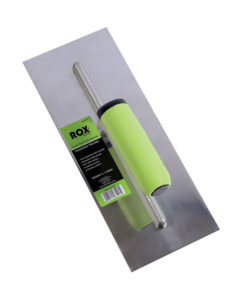
What is a carbon steel finishing trowel used for?
A carbon steel finishing trowel is used to smooth, spread
and refine suitable plaster, cement, concrete and screed
finishes. It helps tradespeople control the material and
produce a more even surface.
What makes the ROX® Contractor Range finishing trowel
suitable for professional use?
The ROX® Contractor Range features a hardened and tempered
high-carbon steel blade, hardwood handle and aluminium
shank. The range offers five- or nine-rivet configurations
and multiple blade lengths.
What sizes are available in the ROX® Carbon Steel
Finishing Trowel range?
The available blade sizes are 280 × 115 mm,
350 × 115 mm, 400 × 115 mm and 450 × 115 mm.
The 280 × 115 mm size is available with five or nine
internal rivets.
What is the difference between a five-rivet and
nine-rivet finishing trowel?
The listed ROX® models differ in the number of internal
rivets used in their construction. Both configurations are
available in the 280 × 115 mm size. Choose the model that
matches your product requirements and preferences.
Why is high-carbon steel used in finishing trowels?
High-carbon steel can be hardened and tempered to provide
useful blade strength and working characteristics. The
finished tool's performance also depends on its blade design,
construction and intended application.
How do I choose the right finishing trowel size?
Consider the work area, material, finishing technique and
level of control required. Shorter blades can be convenient
for smaller or restricted areas, while longer blades cover
more surface per pass where appropriate.
Can a carbon steel finishing trowel be used for plaster?
Yes. The ROX® Contractor Range is specified for plastering,
skimming and finishing suitable plaster surfaces, including
floor and wall finishes.
Can a carbon steel finishing trowel be used on concrete
and screed?
Yes. The published product uses include concrete, cement
and screed finishing. The appropriate technique depends
on the material and its stage of application.
What is the difference between a finishing trowel and
a plastering trowel?
The terms often overlap. A finishing trowel is generally
used to smooth and refine a surface, while plastering trowel
can describe tools used for applying, spreading and finishing
plaster. The correct choice depends on the task and tool
design.
What is the difference between carbon steel and
stainless steel finishing trowels?
Carbon steel blades require careful drying and maintenance
to help prevent rust. Stainless steel generally provides
greater corrosion resistance. The best option depends on
the application, blade characteristics and maintenance
requirements.
How should I clean a carbon steel finishing trowel?
Remove plaster, cement or other residue promptly using
an appropriate cleaning method. Dry the blade thoroughly
before storage and follow the manufacturer's care guidance
to help prevent corrosion.
Is a longer finishing trowel always better?
No. A longer blade covers more surface with each pass,
but a shorter blade may provide better control in restricted
areas or on smaller surfaces. Select the size according
to the application and finishing technique.